

The Machine Behind the Vote - Part II
The lawsuit was only the symptom. The deeper question is what happens when permanent institutions increasingly determine the limits of elected power.

In Part I, we began with a seemingly small dispute inside Independence National Historical Park.
Historical exhibits discussing slavery were removed by executive order and later restored by federal court order.
Most Americans would see that as a routine political fight. One side acted. The other side responded. But the exhibits were never the real story.
The story was the machinery behind the lawsuit and the growing role of permanent legal institutions in shaping, slowing, and redirecting elected power.
That left us with a question: When elections end, who governs next?
THE STRONGEST OBJECTION
The strongest objection to everything written so far is simple.
The administration keeps losing in court because it keeps breaking the law. A judge restoring slavery exhibits is not tyranny. It is the opposite.
That objection deserves a direct answer because part of it is correct.
Consider the case that arrived before Judge Angel Kelley.
In January 2026, the City of Philadelphia filed suit over the same removed slavery exhibits at the President’s House site. Judge Cynthia Rufe, appointed by George W. Bush, ordered the exhibits restored and compared the administration’s claim of total control over the historical narrative to the Ministry of Truth in George Orwell’s 1984.
A Republican appointee. A city government as plaintiff.
No Democracy Forward in sight. The same outcome.
That matters because it proves the partisan explanation was never the real explanation.
THE WRONG QUESTION
The objection was never that Democrats staffed the litigation. The objection was never that judges had been captured.
Judge Rufe was correct on the law. She was correct on the history.
No administration should possess the authority to erase the historical record of slavery from the nation’s founding ground through a memorandum.
One court striking down one unlawful order is the constitutional system functioning as intended.
Citizens who value limited government should want judges willing to refuse lawless actions.
The lawsuit is not the disease. The disease sits one level higher. It sits in the permanence; it sits in the scale.
A government can be wrong, as this one was about the exhibits, and the citizen can still lose because the contest was never theirs to decide.
Consider this: when every contested policy routes through a standing apparatus that no election can disband, the vote becomes the opening bid in a negotiation conducted by lawyers and judges the citizen did not choose and cannot remove.
Being right in court has quietly become the only sovereignty that counts.
Can a republic still govern itself when an election no longer settles a dispute but merely begins one?
THE LONG MIGRATION OF POWER
This did not begin with national parks. It did not begin with Democracy Forward. It did not begin in 2026.
The migration of power beyond the reach of the ballot is one of the defining stories of the postwar era.
Over decades, authority accumulated within:
• Administrative agencies
• Regulatory systems
• International organizations
• Litigation networks
• Permanent institutional structures
Many of these developments were legal. Many were openly debated. Many were created for understandable reasons.
These conditions do not change the result.
The citizens’ practical ability to influence decisions steadily moved further from the ballot box.
THE IMMUNITY QUESTION
One example sits quietly in the historical record.
The International Organizations Immunities Act of 1945 granted broad legal protections to international organizations operating within the United States.
Those protections were not temporary. They became embedded.
The courts continued to define their reach for decades, including the Supreme Court’s 2019 decision in Jam v. International Finance Corporation.
The point is not the details of that case. The point is the pattern.
Congress created a layer of authority.
The courts protected it. The institutions endured.
Administrations came and went, but the structure remained.
The park-sign dispute is only a small and modern expression of that much older trend.
THE PERMANENT CLASS
A free people can survive and prosper through many challenges:
• Losing elections
• Bad policies
• Unpopular presidents
All of those remain accountable.
• Presidents can be voted out.
• Senators can be defeated.
• Representatives can be replaced.
But the permanent institutions increasingly shaping public life operate differently.
Citizens do not vote for:
• Foundation executives
• Litigation directors
• Donor networks
• NGO leadership
• Administrative bureaucracies
Yet those institutions often remain in place long after elected governments change.
Permanence is the form their power takes.
The ability to outlast every administration while shaping the terms under which each administration governs is a kind of authority the Constitution never clearly anticipated.
THE ASYMMETRY
The citizen pays for the system twice.
1. He funds the government whose policies were enacted through elections.
2. He funds the lawyers defending those policies when permanent litigation networks challenge them.
The voter finances the agency. The voter finances the defense. The voter finances the bureaucracy managing the dispute.
The opposing coalition may be privately financed. The government remains publicly financed.
The same citizen funds both sides of a conflict he never directly controls.
That asymmetry is not a side effect. It is part of the machinery.
THE TEMPTATION
It is important not to flinch in either direction.
An administration that answers lawfare with greater executive power has not cured the disease. It has simply caught it.
When the government targets law firms by decree because it dislikes their clients, the same principle is at work.
Power continues moving away from citizens. Only the operator changes. The principle must hold in every direction or it is not a principle.
If nonprofits violate tax law, remedies exist.
If lawyers violate professional obligations, remedies exist.
If agencies exceed their authority, remedies exist.
The answer cannot be another layer of unaccountable power. The answer remains transparency, accountability, and democratic consent.
THE CITIZEN AND THE MACHINE
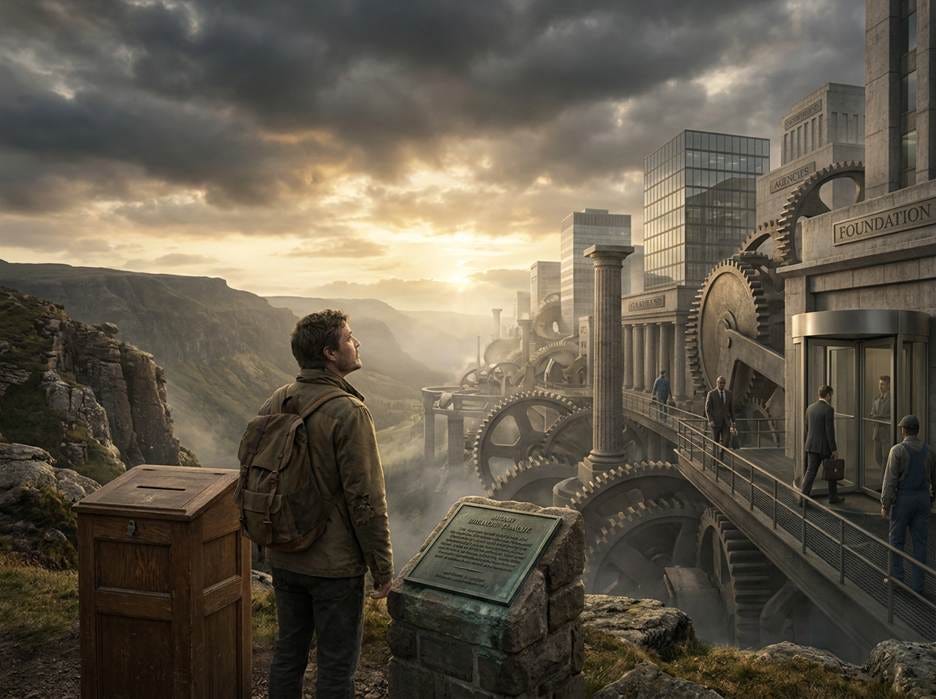
Return to the visitor standing at a National Park. He watched a nameplate disappear through an order he never voted on. He watched it return through a court ruling he never approved.
Nothing in that sequence belonged to him. Every part of it occurred in his name.
That is the deeper story.
The citizen became a spectator of his own government. He is told that power resides in the people. Yet each year, more decisions flow through institutions that operate beyond his reach.
The republic was founded on a harder idea. Power was supposed to remain with the people. Exercised through their consent. Subject to their judgment.
Recovering that principle does not begin with a new law. Reclaiming that power begins with citizens learning to recognize the machinery around them. Including the parts built by their own side.
The temptation in every generation is to keep the machine and simply place a different hand on the lever.
History suggests that temptation never ends well.
The hand may change, but the lever remains.
LET’S WRAP THIS STORY
Taking any historic panels away does not erase the facts.
In part of this investigation, the panels that tell our history tell the truth about a nation that once held human beings in bondage and later struggled to correct that injustice.
The least that history asks in return is a government the people still own.
That ownership requires more than elections. It requires visibility. It requires accountability. It requires citizens willing to ask where power actually resides.
A republic can survive disagreement. It can survive elections. It can survive mistakes.
What it cannot survive indefinitely is the steady transfer of decision-making authority into institutions the public neither understands nor controls.
The challenge before Americans is not simply choosing better leaders.
It is recovering the habit of following power wherever it goes.
That question will outlive every administration.
And the answer will determine whether self-government remains a reality or becomes only a memory.
— Mel K
Follow The Power. Follow The Process. Follow The People.
If you found this investigation valuable, please consider sharing it with others interested in constitutional government, administrative power, NGO influence, litigation networks, and the future of democratic accountability.
I invite you to become a paid subscriber to gain full access to my more in-depth historical investigation insights based on documented evidence. Those Substacks come out on Fridays. Thank you for your continued support!
The most important stories are often hiding in plain sight.
Thanks Mel! Really fascinating article. I was unaware of several things that you so thoughtfully pointed out. It’s become increasingly difficult to not only get all the facts but to have them presented in a way that ties it all together & makes it easier to understand all sides. I watch a lot of news on tv and online, and even with the best of them (Newsmax is a personal favorite!), it still inevitably happens that they miss one or two things or some stories that just go unreported. So I appreciate articles like this! Thanks again, take care, Tom