

Soros After Soros
He named his foundations after the philosopher of fallibility. Then built the kind of institutional architecture the philosopher warned about. Now, that architecture has passed to another generation.

In the autumn of 2018, trucks began carrying books out of Budapest. The cargo belonged to no factory or military installation. It belonged to a university.
Central European University, founded by George Soros as the Soviet system collapsed, announced it would relocate much of its operation to Vienna after years of conflict with Hungary’s elected government. Viewed from Washington or Brussels, the story appeared straightforward: a nationalist government had forced out a liberal institution. Viewed from Budapest, however, an entirely different question emerged. What happens when private wealth becomes powerful enough to build institutions that shape public life across multiple nations without ever standing for election?
That question is older than George Soros. What changed with Soros was its scale. Beneath it lies an even deeper question. The institution, defended in the name of the “open society,” carried the name of a philosopher who may not have recognized what it ultimately became.
To understand why, we have to begin with the revelation.
THE REVELATION
George Soros was born György Schwartz in Budapest on August 12, 1930. His father changed the family name to Soros in 1936, and the young Soros survived the Nazi occupation of Hungary in 1944 using forged identity papers, an experience that taught him an unforgettable lesson: identity can be documented, altered, and, under extraordinary circumstances, become the difference between life and death.
After leaving communist Hungary for London in 1947, Soros enrolled at the London School of Economics, where he encountered the philosopher Karl Popper. Decades later, Soros would describe that encounter as a “revelation” and ultimately name the Open Society Foundations in recognition of Popper’s influence.
Understanding Popper’s ideas is essential because they form the intellectual foundation of everything that follows.
In The Open Society and Its Enemies (1945), Popper argued that no individual or institution possesses absolute truth. Because human knowledge is inherently incomplete, societies must remain open to criticism, correction, and peaceful reform. The defining characteristic of a free society, he believed, was its ability to remove its rulers without violence.
Popper also rejected historical determinism, the belief that history inevitably moves toward a predetermined destination. He warned that any ideology claiming certainty about humanity’s future ultimately drifts toward authoritarianism. For Popper, an open society institutionalized humility by building fallibility directly into the architecture of government itself.
Even today, the Open Society Foundations acknowledge that their name reflects his philosophy.
THE INVERSION
Here, the historical record takes an unexpected turn.
Soros did not simply extend Popper’s thinking. By his own account, he departed from it.
Beginning in the 1990s, Soros argued that the same principle of reflexivity that governs financial markets also applies to politics. In a 2009 Open Society lecture delivered at Central European University and later published by his own foundations, he openly questioned one of Popper’s central assumptions. Popper believed that free political discourse ultimately sought to discover truth. Soros did not.
Instead, he wrote that he had come to give what he called the “manipulative function” pride of place in his own thinking, even wondering publicly how he had followed Popper so unquestioningly.
That admission deserves careful attention. Popper believed no one possessed the final answer and that public debate existed to help societies discover it. Soros concluded something different: public perception itself could be shaped, and shaping perception was central to how political power operates.
To be fair, Soros insisted that truth should ultimately guide that process. Whether the institutional network he later funded reflected that aspiration is the question explored throughout this investigation.
The significance lies in the inversion itself. A movement named after the philosopher who warned against certainty increasingly operated on the premise that public perception could be intentionally influenced.
Popper viewed the open society as a safeguard against concentrated power. The institutional apparatus built under his banner gradually became something else: a system capable of influencing the conditions under which public opinion itself is formed.
Popper directed his philosophy toward those who governed. The institutions that carried his name increasingly directed it toward those being governed.
Ideas alone, however, never reshape nations. They require a mechanism.
REFLEXIVITY
For Soros, that mechanism was reflexivity.
In The Alchemy of Finance (1987) and later in The New Paradigm for Financial Markets (2008), Soros argued that markets do not simply reflect reality. They actively participate in creating it. People act on imperfect perceptions, those actions change events, the changed events reshape perception, and the cycle repeats.
Soros built this theory on two principles, fallibility and reflexivity, insisting it extended far beyond financial markets. He regarded it as his life’s work.
Once removed from finance, the implications become much broader:
Public opinion shapes policy
Policy reshapes institutions
Institutions reshape public opinion
The cycle becomes political, and Soros made that extension himself, applying reflexivity to international affairs, American power, and the management of political expectations.
He never argued that perception alone determines outcomes. He argued that perception becomes one of the forces producing those outcomes. That distinction matters.
If perception helps shape reality, then institutions capable of influencing media, education, law, and civil society become more than observers of political life. They become participants in its continual reconstruction. Popper described how free citizens hold governments accountable. Reflexivity suggests the environment in which citizens form their judgments may itself be shaped long before they cast a vote.
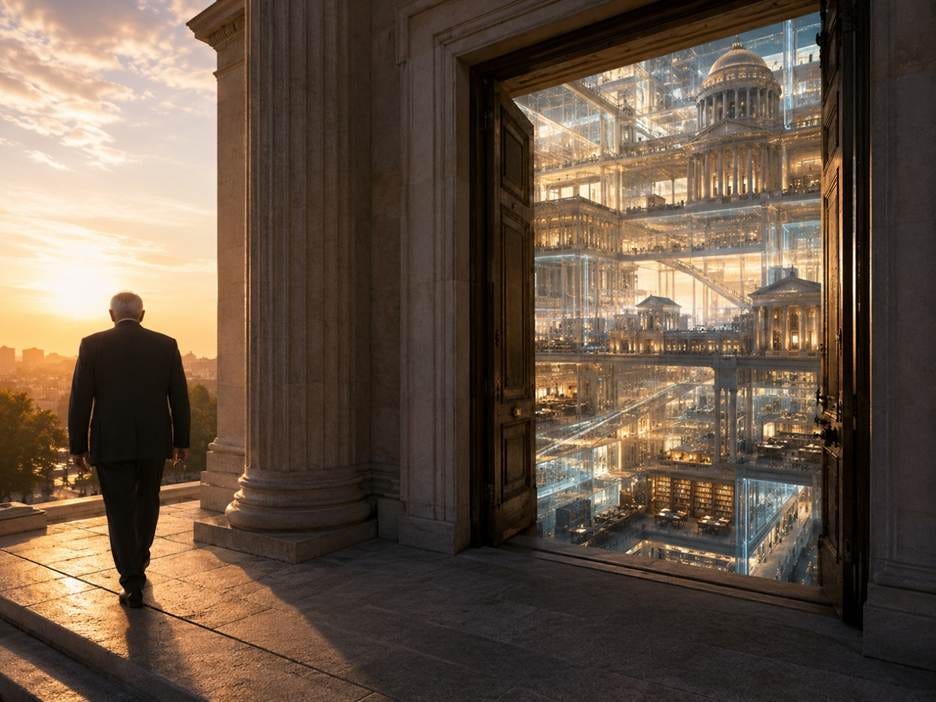
When the architect leaves... why does the architecture remain?
WHAT THIS ARGUMENT IS NOT
Before tracing the institutional network further, one distinction deserves absolute clarity.
George Soros is a Jewish survivor of Nazi-occupied Hungary. For decades, he has also been the target of antisemitic conspiracy theories portraying him as a hidden figure secretly directing world events. Those claims are false, and they ultimately undermine serious inquiry by allowing documented evidence to be dismissed alongside obvious fiction.
This investigation relies on none of those caricatures. This investigation’s foundation is:
Soros’s own published writings
Reports issued by his own foundations
Campaign finance disclosures
Government records
Court documents
The subject is institutional influence, not ancestry, ethnicity, or an imagined global conspiracy.
When the record is held to that standard, the caricature disappears. The documented evidence remains.
THE LESSON OF LEVERAGE
The fortune that made all of this possible began with a principle Soros would apply throughout his career - LEVERAGE.
After launching the investment fund that later became known as Quantum in 1973, Soros developed a simple insight: carefully applied pressure at the weakest point of a system can produce consequences far greater than the force applied.
The world’s attention turned to that principle on September 16, 1992. Quantum built an enormous short position against the British pound, betting Britain could not maintain sterling within Europe’s Exchange Rate Mechanism. When advisers urged caution, Soros reportedly insisted they should “go for the jugular.” Britain exhausted its reserves, raised interest rates, and ultimately withdrew from the system. The British Treasury suffered losses estimated at £3.3 billion, while Quantum reportedly earned approximately $1 billion in a single day.
The lesson extended far beyond currency markets. Find the point of maximum leverage, and a relatively small investment can move a much larger system. Years later, Soros was convicted of insider trading by a French court and fined €2.2 million, a penalty he largely absorbed as a cost of doing business.
The legal case matters less here than the principle itself. Because that principle did not remain confined to financial markets. It became the blueprint for something much larger.
THE VACUUM
Soros did not create the river. He learned to navigate it, then to deepen its channels.
The opportunity emerged as the Soviet system collapsed between 1989 and 1991, leaving one of the greatest institutional vacuums of the modern era. Across the former Eastern Bloc, universities, courts, media organizations, professional classes, and civil-society institutions all required rebuilding at once. The old architecture had fallen away, and the new architecture had yet to take shape.
Few private actors moved into that vacuum more quickly than Soros.
Soros had signed the founding document of his first foundation in Budapest on May 28, 1984. As the Iron Curtain fell, he expanded national foundations throughout the region, chartered Central European University in 1991 to educate a new generation of leaders, and over the following decades directed more than $32 billion through the Open Society network.
History tends to move fastest where institutions are weakest. In the aftermath of the Soviet collapse, philanthropy became something larger than charitable giving. It became institution-building. The investor who had learned to profit from disequilibrium in financial markets found an entire continent in institutional disequilibrium, and the leverage opportunities were immense.
FROM CHARITY TO INFRASTRUCTURE
This kind of philanthropy builds something very different from what the word charity usually suggests.
Traditional philanthropy builds hospitals, libraries, museums, and scholarship funds. Institutional philanthropy builds the systems that shape future decisions.
A university educates the judges, journalists, lawyers, and civil servants who will guide a nation’s institutions for decades, which was precisely the role Central European University was created to play. Litigation networks establish legal precedents that future courts inherit. Election-monitoring organizations help define the standards by which elections are judged legitimate. Prosecutors determine which laws receive vigorous enforcement and which quietly fade into disuse.
None of these institutions governs directly.
Together, however, they shape the environment within which governments govern. Influence gradually migrates upstream, away from the ballot box and toward the institutions that define the range of choices the ballot is ultimately permitted to decide.
That is the quiet center of the model.
The vote remains. The questions it is allowed to settle increasingly emerge from somewhere else.
THE MONEY
Follow the money.
Soros earned his fortune in financial markets before transferring much of it into philanthropy. That is why his personal wealth, estimated at roughly $7 billion, is overshadowed by the institutions carrying his imprint.
The Open Society Foundations report assets exceeding $23 billion and more than $32 billion in grants since 1984, placing the network among the largest private philanthropic organizations in the world. Today, Alexander Soros oversees both the foundations and the family’s investment office, Soros Fund Management, which manages approximately $25 billion.
The political operation developed later, but with increasing focus.
In 2019, Soros created Democracy PAC with an initial contribution of $28.3 million. More than $80 million flowed through the committee during the 2020 election cycle. Two years later, he committed another $125 million to its successor, describing the contribution as a “long-term investment.” Federal disclosures ultimately listed $128 million in contributions during that cycle, all directed toward Democratic causes, making Soros the country’s largest individual political donor by several independent tallies.
The structure matters more than the numbers.
Democracy PAC is funded by Soros and by the Fund for Policy Reform, itself connected to the Open Society network, while Alexander Soros serves as its president. The charitable foundation, family investment office, and political action committee do not function as isolated organizations.
They operate as different chambers within the same house.
THE VOCABULARY AS PRESSURE
The question is no longer whether Soros funds political causes. That is well documented.
The more interesting question is how political influence is often presented as something other than politics. This is where the civil-society model demonstrates its greatest strength.
It does not arrive carrying party banners, military uniforms, or colonial administrations. Instead, it appears through lawyers, grant programs, university initiatives, policy institutes, media monitors, election-watch organizations, migration advocates, anti-corruption groups, and human-rights organizations. Each serves an identifiable public purpose. Viewed individually, each appears modest.
Viewed together, they form a pressure system capable of surrounding a sovereign government from multiple directions while insisting that none of it is political.
Hungary named that mechanism long before much of Western Europe or the United States was willing to do so. Officials accused Soros-supported organizations of attempting to reshape Hungarian migration policy through coordinated pressure extending beyond Budapest into Brussels and Berlin, culminating in the 2018 legislative package known as “Stop Soros.”
The pattern follows a familiar rhythm.
An NGO publishes a report
Media organizations amplify it
European institutions reference it
Activist networks mobilize around it
When governments resist, that resistance itself becomes evidence of authoritarianism.
Russia responded differently, declaring the Open Society Foundations and the Open Society Institute Assistance Foundation “undesirable organizations” in 2015, arguing that their activities threatened the country’s constitutional order and national security.
Whatever conclusions readers reach about Hungary or Russia, the documented record shows something significant: governments increasingly viewed foreign-funded NGO networks not simply as charitable organizations, but as instruments capable of influencing domestic political life.
The deeper lesson moves beyond the caricature of one individual secretly directing every outcome.
Soros does not need to command every institution personally, and the network itself does not require it. It operates through incentives, grants, professional advancement, shared language, and common institutional priorities. Sustain that ecosystem long enough, and it develops momentum of its own. Participants gradually learn which ideas attract funding, which language opens opportunities, which governments are viewed as obstacles, and which forms of resistance are redefined.
The public face is charity. The operating principle is leverage. The strategic objective is influence over the terms by which nations define themselves.
BORDERS AS THE OBSTACLE
The theory became unmistakably concrete in 2015.
In an essay titled "Rebuilding the Asylum System," published by Project Syndicate on September 26 of that year, Soros proposed that the European Union commit to accepting at least 1 million asylum seekers annually for the foreseeable future, financing the effort through EU-backed borrowing at a projected cost of at least €30 billion per year.
A month later, he framed the debate even more directly, contrasting one approach that treated national borders as the obstacle with another that treated them as the objective.
Placed beside Popper’s philosophy, the contrast is striking.
Popper argued that no one possesses the final answer to political questions.
Soros wrote about the future of national membership as though the answer had already been settled, leaving elected governments that disagreed to appear as obstacles to implementation.
Migration, in this framework, was never only about migration. It became a question of authority.
Who ultimately decides the future of a nation: the citizens living within its borders, or the institutional networks seeking to reshape them?
That question carries us from European experiments to the American laboratory, where the same principles would be tested in a different political system.
THE AMERICAN LABORATORY
The institutional architecture refined overseas eventually returned home, and it did so through the same principle Soros had learned in the financial markets decades earlier.
The American prototype was smaller than the strategy it eventually became. During the 2004 race for district attorney in Albany County, New York, Soros-backed candidate P. David Soares defeated the Democratic establishment after mobilization through the Working Families Party, an organization that emerged from ACORN. The template was established there: bypass the traditional party structure, elevate a candidate through an ostensibly independent vehicle, and capture a single office with enormous discretion over how laws are enforced.
Over the next two decades, the model expanded dramatically. Between 2012 and 2022, Soros directed roughly $40 million through Justice and Public Safety PAC and a network of similarly named committees supporting approximately seventy-five prosecutors in jurisdictions representing nearly one-fifth of the American population.
Philadelphia offers perhaps the clearest case study. In 2017, Soros-funded organizations supplied roughly $1.7 million, accounting for about 90% of Larry Krasner’s campaign funding. Krasner won a crowded Democratic primary with just 38% of the vote in an election where only 17% of eligible voters participated. In a one-party city, the office effectively fell into his hands with the support of fewer than 7% of eligible voters.
One City Journal analysis captured the broader significance. Soros had effectively taken a “short position” on the traditional role of American prosecutors, investing relatively small sums at points of maximum institutional leverage in pursuit of disproportionately large political returns.
The Black Wednesday principle had been adapted from currency markets to the American justice system.
The historical record also requires the other half of the story.
That strategy has increasingly encountered its limits at the ballot box.
San Francisco voters recalled Chesa Boudin in 2022
Pennsylvania’s House of Representatives impeached Larry Krasner that same year
George Gascón lost reelection in Los Angeles in 2024
Kim Foxx declined to seek another term in Chicago
By several published counts, more than twenty Soros-backed prosecutors have since been replaced by successors promising a different approach.
The leverage proved powerful. It was not permanent.
Ultimately, citizens retained the ability to vote, precisely the safeguard Popper believed every free society must preserve. The institutional mechanism eventually met the constitutional check it could not bypass.
THE PERSONNEL PRINCIPLE
This is why the more interesting question is not the one posed by conspiracy theories.
Mature institutional systems rarely require a central command issuing daily instructions. Instead, personnel circulate among universities, foundations, nonprofit organizations, government agencies, journalism, and the courts, carrying common training, professional incentives, institutional language, and funding networks. That circulation alone can produce remarkable continuity without anyone directing every individual decision.
Whitney Tymas provides a useful illustration. Before becoming president and treasurer of Soros-backed prosecutor committees, she directed the prosecution program at the Vera Institute of Justice, itself a significant recipient of Open Society funding. No direct instruction is needed between those positions for the institutions to continue moving in similar directions.
The more useful question, therefore, becomes not, Who gave the order? It is, Which institutions educated, rewarded, and advanced the people who independently arrived at remarkably similar conclusions?
That distinction separates institutional analysis from caricature.
SOROS AFTER SOROS
Every institutional architecture ultimately faces one defining test.
Can it survive its founder?
This one appears to have been designed to do exactly that.
In December 2022, the Open Society Foundations reorganized their governing board around a smaller group of family members and longtime advisers, selecting Alexander Soros as chairman. Six months later, George Soros publicly confirmed the succession in The Wall Street Journal, transferring control of both the foundations and oversight of the family’s investment office to his younger son.
The transition was not simply one of inheritance. It was one of consolidation.
Within weeks, the new leadership announced plans to eliminate at least forty percent of the organization’s approximately 800 employees, continuing a significant reduction from a workforce that had once approached 1,700. Offices across Africa would close, European operations would shrink substantially, and the foundations would narrow their priorities while shifting increasing attention toward the United States.
Alexander Soros has openly described himself as “more political” than his father. He serves as president of the family’s principal political committee and has publicly stated that political giving will continue “as long as the other side is doing it.”
The succession reveals something larger than a change in leadership.
George Soros did not merely build an organization. He built an institutional system that could function without him.
The founder has stepped aside. Much of the staff has departed. Entire regional operations have been reduced or eliminated. The architecture remains.
A fortune that once belonged to an individual has become an enduring institution.
Institutions do not retire.
They do not run for office.
They cannot be voted out.
The inversion now has an heir.
THE OPEN SOCIETY AND ITS ENEMY
This is where the documentary record ultimately leads.
Whether George Soros has been influential is no longer a serious question. The more significant question is what his career reveals about the changing nature of institutional power.
A philosophy that began as an acknowledgment of human fallibility gradually evolved, through the work of its most famous disciple, into an institutional apparatus capable of shaping the civic, legal, educational, and political environment within which public decisions are made.
Popper directed the open society toward those who governed, believing citizens should retain the peaceful ability to remove them from power. The institutions that emerged under his philosophical banner increasingly focused on the environment in which citizens themselves formed political judgment.
Soros belongs to a much older American tradition.
Long before him, great private fortunes established enduring public institutions. The Carnegie Corporation, chartered in 1911, the Rockefeller Foundation in 1913, and the Ford Foundation in 1936 each transformed private wealth into universities, research institutions, and long-term policy influence.
Soros did not invent that model. He adapted it to the post-Cold War world, expanded it across national borders with unusual speed and scale, and connected it to a theory in which perception itself becomes one of the forces shaping political reality.
That is what makes him more than a historical curiosity. It makes him a case study in the modern evolution of institutional power.
Whether history ultimately remembers that achievement as philanthropy, democratic development, political intervention, or soft-power influence will remain a matter of debate. An honest investigation leaves that judgment to the reader after examining the documentary record.
What is far more difficult to dispute is the scale of the institutional architecture that emerged, its durability across decades, its ability to cross national borders without a single election, and its successful transfer to a new generation that openly intends to continue its work.
The twentieth century taught nations to recognize threats that arrived in uniform.
The twenty-first century increasingly confronts something different: influence exercised through philanthropy, expertise, civil society, institutional development, and reform. Those mechanisms operate quietly, often legally, and frequently outside the traditional categories through which previous generations learned to recognize power.
The modern world was not built through invasion.
It was built through infiltration.
Liberty. Transparency. Truth. Justice.
- Mel K
George Soros is one of the main figure heads within the Democratic Party, you can't campaign for thr party without his backing. Antifa, BLM, and many other liberal organizations are backed by him, which partly explains the far-left agenda of the democrats. Outstanding article, Mel K.
I love this!! Mel, I have to tell you that I'm loving your book. I'm a highlighter, and there are more highlighted lines than not. It's a brilliant book!.